









No products in the cart.
- Latest
- Trending

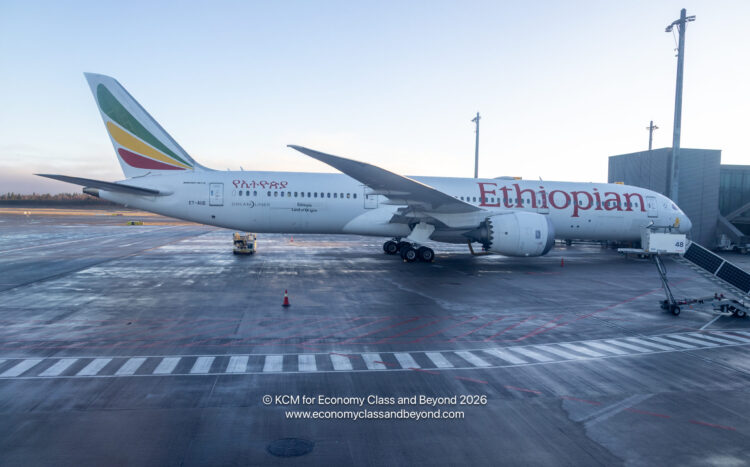
Airplane Art - Ethiopian Airlines Boeing 787-9 at Oslo Airport
Comprehensive Summarization:
The article features a photograph of an Ethiopian Airlines Boeing 787-9 aircraft at Oslo Airport, awaiting its return journey to Addis Ababa. This Boeing 787-9 is part of Ethiopian Airlines’ widebody fleet, which also includes Airbus A350-900, Airbus A350-1000, Boeing 767-300ER, Boeing 777-200LR, Boeing 777-300ER, and Boeing 787-8 aircraft. The Boeing 787-9 in question is registered as ET-AUQ and is highlighted as one of the nine Boeing 787-9 aircraft in Ethiopian Airlines’ fleet. The article does not delve into recent travel trends or insights from thought leaders, focusing instead on a specific aircraft and its fleet context.
Key Points:
Actionable Takeaways:
Fleet Management Insight: The presence of multiple aircraft types in Ethiopian Airlines’ widebody fleet, including the Boeing 787-9, highlights the airline’s strategic approach to fleet management. Airlines are increasingly diversifying their fleets to optimize routes, fuel efficiency, and passenger capacity, reflecting broader industry trends towards flexible and adaptable air travel infrastructure.
Operational Efficiency: The registration number ET-AUQ provides a tangible example of how airlines manage their aircraft assets. Efficiently tracking and managing aircraft registrations can enhance operational efficiency, streamline maintenance schedules, and improve overall fleet performance. This level of detail is crucial for airlines aiming to maintain high service standards and competitive pricing.
Contextual Insights:
The focus on a specific Boeing 787-9 aircraft at Oslo Airport underscores the importance of regional hubs in global air travel. Oslo Airport, as a major hub, plays a critical role in connecting European travelers to Africa, exemplifying the interconnectedness of global air networks. This context is particularly relevant in the current travel landscape, where regional hubs serve as critical nodes for both passenger and cargo traffic. The article’s emphasis on Ethiopian Airlines’ Boeing 787-9 also highlights the airline’s role in bridging East Africa with Europe, a route that is increasingly important for both business and leisure travel. As the travel industry continues to evolve, understanding the strategic importance of regional hubs and the role of specific aircraft types will be essential for stakeholders aiming to navigate the complexities of modern air travel.
Read the Complete Article.
Get curated travel AI insights — choose the newsletters that matter to you.
This spot is reserved for brands with a compelling story for the travel trade. They use this space to cut...
Read moreDetailsALTOUR Expands into Thailand, Strengthening Corporate Travel Network Across Southeast Asia BANGKOK, THAILAND (25 March, 2026) – ALTOUR, a leading...
Read moreDetails


Comprehensive Summarization: The article highlights the launch of Navi Mumbai International Airport for its first complete operational summer season from...
Read moreDetails