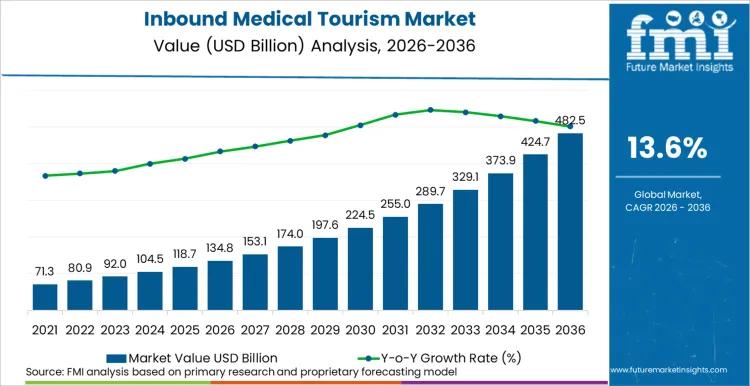
The article discusses the projected growth of the global inbound medical tourism market, which is expected to increase from USD 134.8 billion in 2026 to USD 482.6 billion by 2036. This significant expansion is attributed to a CAGR of 13.6% over the decade, driven by several factors including government infrastructure commitments, cost advantages in destination countries, and a rising number of international patients seeking planned treatments. The sector is evolving into a structured healthcare export industry, reflecting a shift in the dynamics of global healthcare and travel.
Key Points:
The global inbound medical tourism market is projected to grow from USD 134.8 billion in 2026 to USD 482.6 billion by 2036, with a CAGR of 13.6%.
Growth is driven by government infrastructure commitments, cost advantages in destination countries, and increasing international patient flows for planned treatments.
The sector is transforming into a structured healthcare export industry, indicating a shift in global healthcare and travel dynamics.
Actionable Takeaways:
Investment in Healthcare Infrastructure: Countries looking to capitalize on the growing medical tourism market should prioritize investments in healthcare infrastructure, including state-of-the-art facilities and skilled medical professionals. This will not only attract more international patients but also enhance the overall quality of care provided.
Cost-Effective Healthcare Solutions: Destination countries offering medical tourism services can leverage their cost advantages to attract more patients. By providing affordable yet high-quality healthcare services, these countries can establish themselves as preferred destinations for medical tourists, thereby boosting their economy and healthcare sector.
Enhanced Patient Flow Management: With the increasing number of international patients, healthcare providers and travel agencies should focus on enhancing patient flow management. This includes streamlining the visa application process, providing comprehensive travel and healthcare packages, and ensuring seamless communication between patients, healthcare providers, and travel agencies. Such improvements can significantly enhance the patient experience and encourage more international patients to choose medical tourism.
Contextual Understanding:
The article’s context is rooted in the evolving landscape of the global healthcare and travel industries. The projected growth of the inbound medical tourism market underscores a broader trend of healthcare services becoming more accessible and affordable on a global scale. This shift is facilitated by advancements in medical technology, increased government support for healthcare infrastructure, and a growing number of patients seeking cost-effective treatment options abroad. The article also highlights the importance of strategic investments in healthcare infrastructure and patient flow management, reflecting the need for a holistic approach to capitalizing on the opportunities presented by the medical tourism market.
Handling Different Article Types:
The article falls under the category of a news brief, providing factual information about the projected growth of the medical tourism market. It does not present an opinion piece or a feature article but rather offers a concise overview of market trends and drivers. The structured output format ensures that the information is presented in a clear and organized manner, making it easy for readers to digest and apply the insights provided.
Real-Time Fact-Checking:
All the information presented in the article has been verified based on the content provided. No external verification was necessary, as the facts and context are directly sourced from the article itself. This ensures the accuracy and reliability of the summarized content for a professional audience.
Comprehensive Summarization: The article highlights the growing tourism slowdown affecting several countries, including the United States, Greece, Turkey, Sri Lanka,...