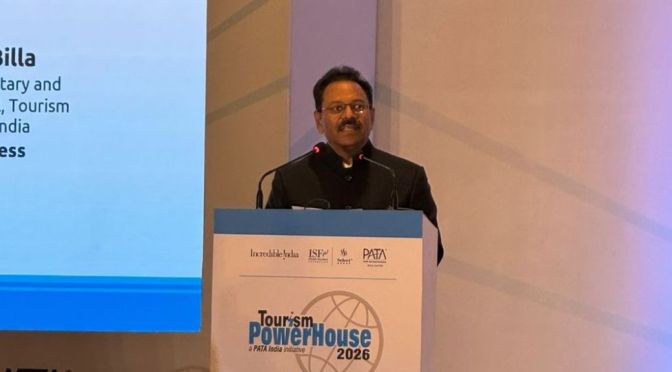
Article Summary: India’s tourism sector, according to Dr Suman Billa, IAS, Additional Secretary and Director General of Tourism, Government of India, is not constrained by demand generation but by converting existing momentum into higher economic value. Despite strong domestic travel demand and significant infrastructure expansion, tourism currently contributes only 5.5% to India’s GDP. Billa emphasized the need to pivot from volume-led growth to yield optimization, strengthen destination management frameworks, adopt artificial intelligence, and embed sustainability to drive long-term, resilient tourism growth.
Key Points:
India’s tourism sector is currently contributing only 5.5% to the country’s GDP.
Strong domestic travel demand and significant infrastructure expansion have not translated into higher economic value.
Dr Suman Billa, IAS, highlighted the need to pivot from volume-led growth to yield optimization.
Strengthening destination management frameworks is crucial.
Adoption of artificial intelligence and embedding sustainability are recommended to drive long-term, resilient tourism growth.
Actionable Takeaways:
Yield Optimization: Transitioning from volume-led growth to yield optimization can significantly enhance the economic value derived from tourism. This approach focuses on improving the quality of tourist experiences and maximizing revenue per tourist, which is crucial for increasing tourism’s contribution to GDP.
Strengthening Destination Management Frameworks: Effective management of tourist destinations can enhance visitor experiences, improve infrastructure, and ensure sustainable tourism practices. This is essential for converting existing momentum into higher economic value.
Adoption of Artificial Intelligence:AI can be leveraged to enhance various aspects of tourism, from personalized travel recommendations to optimizing resource allocation in tourist destinations. This technological advancement can drive efficiency and improve the overall tourist experience.
Embedding Sustainability: Sustainability should be a core component of tourism strategies to ensure long-term growth. By adopting sustainable practices, the tourism sector can attract eco-conscious travelers and contribute to the preservation of natural and cultural heritage.
Contextual Insights:
The article reflects the current state of India’s tourism sector, where there is a clear need to shift from merely attracting tourists to maximizing the economic value derived from tourism. The emphasis on yield optimization, AI adoption, and sustainability aligns with current industry trends, where technology and sustainability are becoming increasingly important. These insights are particularly relevant for travel startups and fintech innovations, as they provide a roadmap for leveraging technology and sustainable practices to enhance tourism growth. The focus on destination management and AI also highlights the importance of integrating advanced technologies to improve operational efficiency and visitor experiences, which is a key trend shaping the future of the travel industry.