This insightful panel discussion, moderated by a representative from Web in Travel, delved into the evolving landscape of airline technology, with a particular focus on the innovations and challenges facing the Middle Eastern aviation sector. The conversation featured Rami al Khaja, VP of Technology at Emirates, and Shakir Alzaidi, CEO of SABRE, offering perspectives from both a leading global airline and a major technology provider to the travel industry.
The discussion opened with Rami al Khaja highlighting Emirates’ significant digital transformation journey, accelerated by the pandemic, focusing on leveraging technology to enhance the customer experience and operational efficiency. He emphasized the sheer scale of Emirates’ operations and the complexity of managing a vast global network, necessitating robust, scalable, and secure technological solutions. Key initiatives at Emirates include advancing biometrics for a frictionless journey, enhancing self-service options, and deeply integrating data and AI to personalize interactions and optimize operations. Khaja stressed the importance of balancing innovation with the stability and security required for mission-critical airline systems, noting the challenge of migrating legacy infrastructure while simultaneously introducing cutting-edge solutions.
Shakir Alzaidi from SABRE provided a complementary perspective, outlining how technology partners are supporting airlines in their digital ambitions. He underscored SABRE’s role in powering the global travel ecosystem, facilitating connections between airlines, travel agencies, and consumers. Alzaidi discussed SABRE’s strategic shift towards cloud-native solutions, its partnership with Google Cloud, and the focus on delivering modular, API-driven platforms that enable airlines to innovate faster and offer more personalized retail experiences. He highlighted the importance of data analytics and AI in understanding customer behavior and optimizing offers, moving beyond traditional fare-based selling to a more comprehensive “experience” retailing model. Both speakers agreed on the critical role of talent, cybersecurity, and adaptable technological architectures in navigating the industry’s future. The conversation ultimately painted a picture of an industry rapidly embracing digital-first strategies to meet sophisticated customer expectations and achieve operational excellence, with collaboration between airlines and technology providers being paramount.
Key Data Points (Facts, Figures, & Statistics)
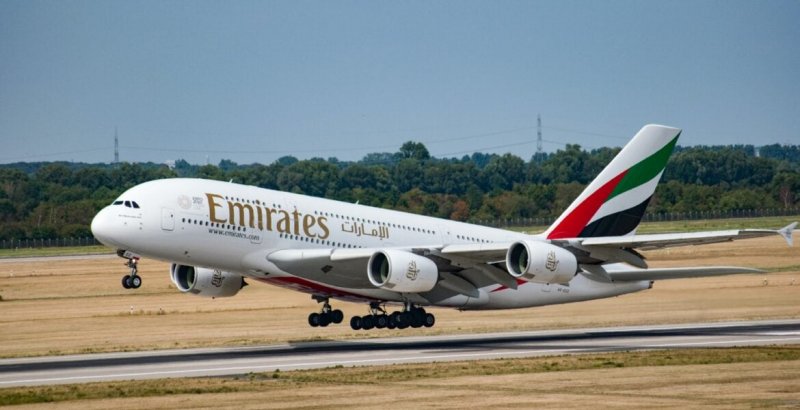
Emirates currently has 170 aircraft flying, compared to 270 aircraft pre-pandemic [Rami al Khaja, Emirates].
Emirates operates to 130 destinations across 6 continents [Rami al Khaja, Emirates].
Emirates employs approximately 75,000 people [Rami al Khaja, Emirates].
SABRE’s platform is utilized by 67,000 travel agencies worldwide [Shakir Alzaidi, SABRE].
SABRE has been working on a significant cloud migration project for over four years, partnering with Google Cloud [Shakir Alzaidi, SABRE].
Emirates expects its full migration of mission-critical systems to the cloud to take 3-5 years [Rami al Khaja, Emirates].
The Middle East travel sector is seeing a “boom” in demand, demonstrating faster recovery than other regions [Shakir Alzaidi, SABRE].
The transition to New Distribution Capability (NDC) is described as an “evolutionary process,” not a “revolutionary process,” indicating a gradual shift [Shakir Alzaidi, SABRE].
Travel Industry Insights (Trends, Predictions, & Announcements)
Notable Trends:
Hyper-Personalization and Experience Retailing: There’s a significant shift from selling mere “products” (like air tickets) to offering highly personalized “experiences” throughout the customer journey, from booking to post-travel. This is driven by sophisticated data analytics and AI.
Seamless, Frictionless Customer Journey: Airlines are heavily investing in technologies like biometrics (e.g., smart tunnels, facial recognition) and advanced self-service options to create a completely touchless and effortless passenger experience at airports and across digital touchpoints.
Digital Transformation Acceleration: The COVID-19 pandemic significantly accelerated airlines’ digital transformation efforts, pushing them to embrace new technologies and digital channels at an unprecedented pace to meet changing customer demands and operational needs.
Cloud Adoption for Agility and Scale: Airlines and their technology partners are increasingly migrating mission-critical systems to cloud-native platforms to achieve greater scalability, resilience, and agility in deploying new services and features.
Data-Driven Decision Making: The reliance on vast amounts of data and advanced analytics is growing exponentially, enabling airlines to make more informed decisions across operations, customer engagement, and revenue management.
Modular, API-Driven Architectures: Technology providers are moving towards modular, API-first platforms that allow airlines to integrate new capabilities more flexibly and customize their offerings rapidly, fostering innovation.
Evolving Distribution Landscape (NDC): The industry is gradually moving towards New Distribution Capability (NDC) to enable richer content and more flexible retailing for airlines, although this is acknowledged as an ongoing, evolutionary process.
Predictions & Projections:
Continued Growth in Middle East Aviation: The Middle East is projected to continue experiencing robust growth and recovery in the travel sector, potentially outpacing other global regions.
Increased AI and Automation for Operational Efficiency: Future operations will see an even greater integration of AI for predictive maintenance, resource optimization, disruption management, and enhancing efficiency across all airline functions.
Shifting Talent Requirements: The industry will require a new breed of talent proficient in data science, cybersecurity, cloud architecture, and AI, necessitating continuous upskilling and a focus on attracting tech talent.
Enhanced Cybersecurity Focus: As digital reliance grows, cybersecurity will remain a paramount concern, with ongoing investments in protecting critical infrastructure and passenger data.
Further Integration of Digital Touchpoints: The number and sophistication of digital interactions throughout the customer journey are expected to increase, leading to a more interconnected and context-aware experience.
Key Announcements:
Emirates’ Cloud Migration Initiative: Emirates announced its strategic initiative to migrate mission-critical systems to the cloud over the next 3-5 years, aiming for greater agility and efficiency.
SABRE’s Google Cloud Partnership: SABRE highlighted its extensive, multi-year partnership with Google Cloud, signifying a major industry move towards cloud-native infrastructure for core travel technology systems.
Emirates’ Biometrics Rollout: Emirates detailed its ongoing rollout of biometrics technologies, including smart tunnels and self-service kiosks, to facilitate a seamless, paperless, and frictionless customer journey at the airport.
Comprehensive Summarization: The article highlights the growing tourism slowdown affecting several countries, including the United States, Greece, Turkey, Sri Lanka,...