



No products in the cart.
- Latest
- Trending


Indian airlines seek fair play as Europe squeezes slots
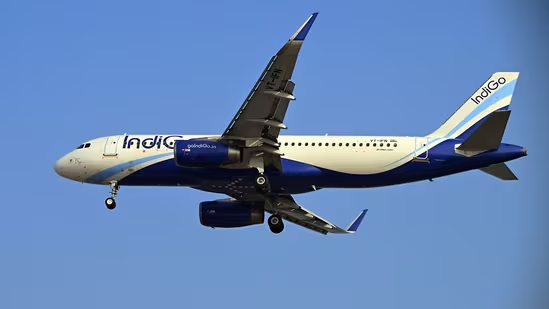
The Indian aviation sector is grappling with a significant challenge: securing and retaining vital airport slots in European hubs. This issue, critical for expanding India-Europe connectivity, sees Indian carriers disadvantaged while their European counterparts enjoy substantial growth in the Indian market, creating an unlevel playing field for the global travel industry.
Indian airlines like Air India, Vistara, and IndiGo are finding it increasingly difficult to operate and expand services to key European cities. Post-COVID-19, as slot waivers expire and the "use it or lose it" rule (requiring 80% slot utilisation) returns, Indian carriers face the risk of losing their hard-won access. This is particularly evident in the UK, where Air India’s London Heathrow slots were reduced, and in Germany, France, and the Netherlands, where European carriers like Lufthansa, Air France, and KLM significantly outnumber Indian operations in terms of weekly flights. The difficulty in acquiring new slots, even when market demand exists, severely hampers the ability of Indian airlines to grow their international networks.
At the heart of the matter is a perceived lack of reciprocity in air traffic rights and slot allocation. While European airlines benefit from relatively open access and ample traffic rights to India, Indian carriers encounter significant hurdles, with limited slots hindering their ability to leverage existing bilateral air services agreements. This imbalance creates a competitive disadvantage, impacting the growth potential of Indian airlines and, consequently, limiting direct air connectivity options for travellers and businesses alike. From a travel industry perspective, this directly translates to fewer choices, potentially higher airfares due to limited supply, and reduced flexibility for both inbound and outbound tourism and trade between India and Europe.
The Indian airline industry is urgently urging the government to intervene, advocating for a thorough review of existing bilateral agreements and demanding fair and reciprocal treatment. Unrestricted market access for Indian carriers is crucial for fostering competitive airfares, diversifying route options, and ultimately boosting both inbound and outbound tourism and trade. Without a swift and equitable resolution, this disparity could hinder India’s ambition to become a global aviation hub and limit the expansion of vital economic and cultural links. Strategic diplomatic efforts are essential to ensure Indian airlines can compete effectively on the global stage, fostering robust and equitable air travel networks that benefit all stakeholders.
Key Points
Read the Complete Article.
Get curated travel AI insights — choose the newsletters that matter to you.
This spot is reserved for brands with a compelling story for the travel trade. They use this space to cut...
Read moreDetailsTravel One Technologies launches the world’s first Traveler DNA Platform, targeting the structural data gap at the core of an...
Read moreDetails