







![Panoramic View of Gimpo International Airport. [Korea Airports Corporation]](https://images.traveltrade.today/wp-content/uploads/2026/03/Jeju-Air-Announces-May-Launch-of-Jeju–Incheon-Route.jpg)


No products in the cart.
- Latest
- Trending

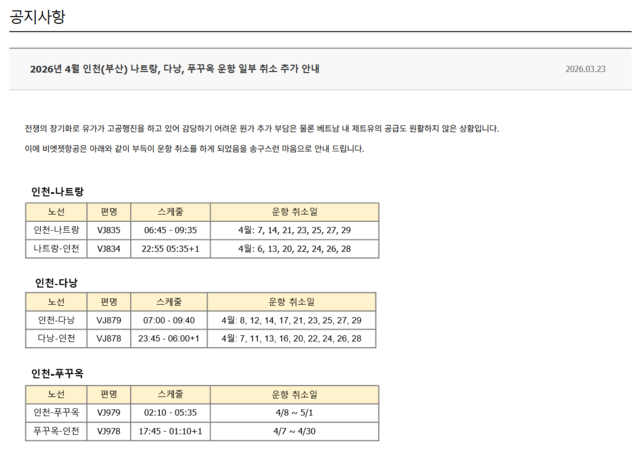
"Can't fly to Vietnam starting next week"… Flights canceled one after another due to soaring fuel prices, a bolt from the blue
Comprehensive Summarization:
VietJet Air, a Vietnamese low-cost carrier, has abruptly canceled numerous Korea-Vietnam flights due to soaring oil prices, primarily driven by the U.S.-Iran war. This decision, effective starting next week, has left travelers scrambling as flights scheduled for March and April have been canceled. The article highlights the significant impact on travelers and the broader travel industry, emphasizing the ripple effects of fuel price surges on airline operations and passenger travel plans.
Key Points:
Actionable Takeaways:
Fuel Price Sensitivity in Air Travel: The article underscores the sensitivity of air travel to fuel prices, particularly in the context of geopolitical events. Airlines must closely monitor global oil price fluctuations and develop contingency plans to mitigate the impact on their operations and customer experience. This highlights the need for airlines to invest in fuel-efficient technologies and explore alternative energy sources to reduce dependency on volatile oil markets.
Impact on Traveler Planning: The abrupt cancellations have created significant disruptions for travelers, emphasizing the importance of flexible booking options and robust customer support systems. Travel agencies and airlines should consider implementing dynamic pricing models and offering enhanced customer service to manage such disruptions effectively. This can help maintain customer trust and loyalty during times of uncertainty.
Contextual Insights:
The cancellation of flights by VietJet Air is a direct consequence of the escalating fuel prices, which are influenced by geopolitical tensions such as the U.S.-Iran war. This situation highlights the broader trend of travel industry vulnerability to external geopolitical factors. As the travel industry continues to evolve, it is crucial for stakeholders to remain agile and responsive to such disruptions. The article also points to the increasing importance of technological innovations in travel, such as dynamic pricing and flexible booking options, which can help airlines and travel agencies adapt to changing market conditions more effectively. Furthermore, the focus on fuel efficiency and alternative energy sources reflects a growing trend towards sustainability within the travel sector, driven by both regulatory pressures and consumer demand for environmentally responsible travel options.
Read the Complete Article.
Get curated travel AI insights — choose the newsletters that matter to you.
This spot is reserved for brands with a compelling story for the travel trade. They use this space to cut...
Read moreDetailsTravel One Technologies launches the world’s first Traveler DNA Platform, targeting the structural data gap at the core of an...
Read moreDetails