

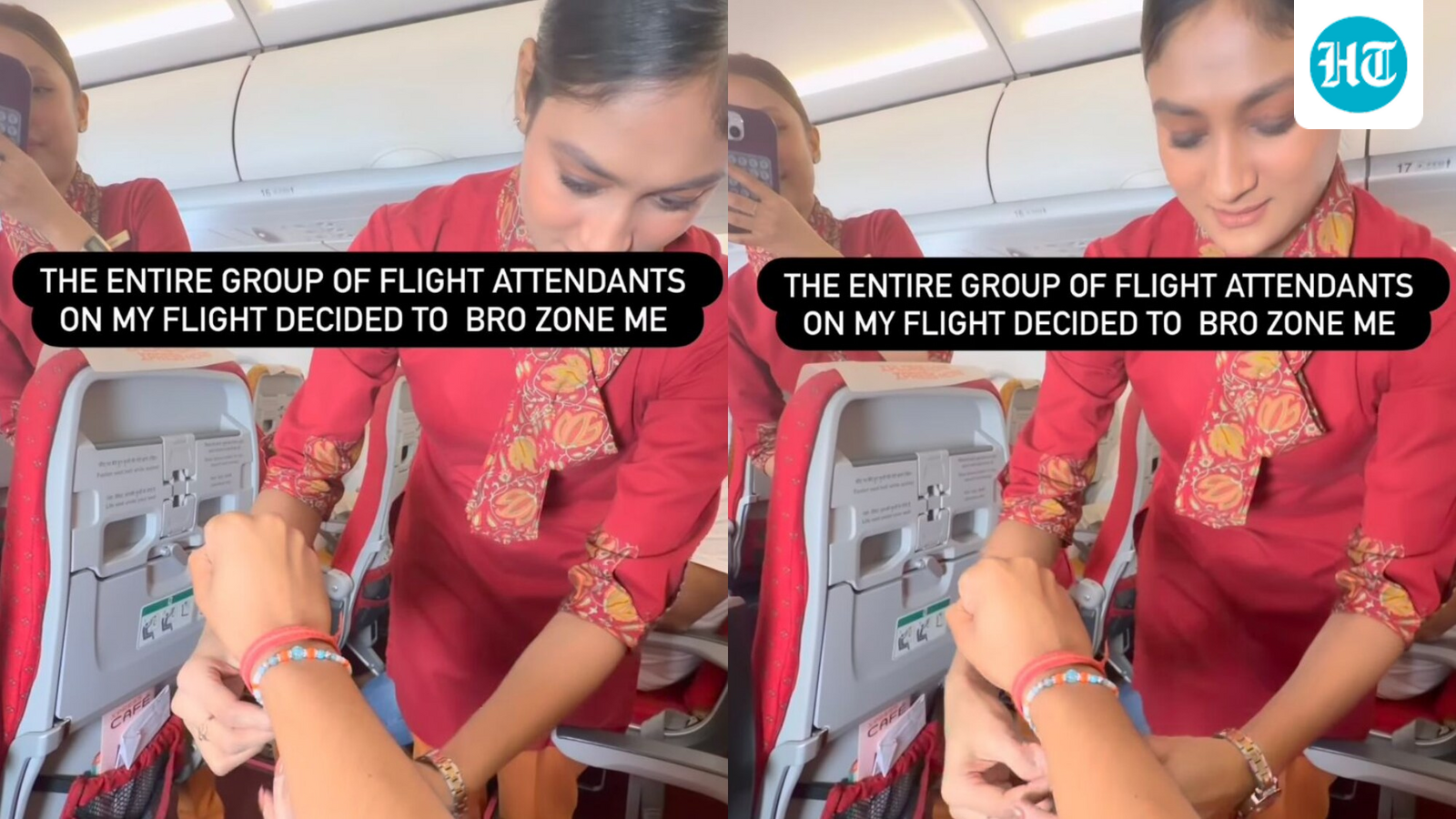
Air India cabin crew ties Rakhi to passenger, alleges bro‑zone harassment
THE NEWS: Air India cabin crew member tied a Rakhi to a passenger during a flight, a celebration of the...
Read moreDetailsEvery alert that matters — when it happens.

IndiGo’s growth over the years has mirrored and, in many ways, led the rapid expansion of India’s aviation market. India’s largest airline, which now aims to double in size by the end of the decade from the current 2,000 daily flights and around 3 lakh daily passengers, is currently traversing a period of swift fleet and network expansion, product evolution, and internationalisation, all in the face of the broadening Indian flyer base, growing competition, particularly from the Tata-backed Air India group, and the still persisting supply chain issues and engine woes.
In a candid interaction, IndiGo’s Chief Executive Officer PIETER ELBERS speaks to SUKALP SHARMA about the airline’s flight plan, the potential of India’s aviation market, and more. Edited excerpts:
Plane groundings — aircraft on ground (AOG) — due to engine troubles and supply chain problems has been a concern for some time now for IndiGo. What is the current situation like?
We have taken a whole range of mitigating measures, thanks to which we have been able to live up to our capacity (growth) guidance. Our measures included additional damp leases, lease extensions, bringing back some phased-out planes, and of course the most important part, a steady flow of new planes coming in, has the relative size of the problem.
We gave a capacity guidance for FY24 in the north of the mid-teens, and we achieved that in the first three quarters. At the end of the fourth quarter, the actual AOG number is in the early 70s. Although still a high number, it is slightly lower than initially foreseen. And we have now given capacity guidance for FY25 in the early double-digits.

We are in permanent discussion and dialogue with Pratt & Whitney (engine manufacturer) on what would be the actual supply of engines, and also make some predictions going forward. Of course, we talked with them on what this does for IndiGo and how to make sure that all the effects are not borne by IndiGo alone.
Are you actively considering having a wide body aircraft fleet? There have been recent reports suggesting IndiGo is interested in the Airbus A350.
Before that there were reports that we were considering another wide body type, right? IndiGo keeps constantly evaluating options and keeps the flexibility to decide at what point in time it would make sense to make those decisions… What is important on internationalisation is that we do have the XLR (extra-long range variant of the narrow body Airbus A321 aircraft) on order, and they will be coming in due course of 2025. We are awaiting some details from Airbus. The XLR will allow us to further build and expand our international network (as they would offer direct connectivity between India and parts of Europe and Far East Asia).
Any clarity yet on the number of XLRs that are going to come as part of your order for 500 Airbus narrow body aircraft? And would they come in a dual-class configuration or the regulation all-economy cabin?
There is still some flexibility. But I would dare to say that whatever IndiGo does, on the basis of the significant Indian population, and the enormous market potential, it wouldn’t make sense to start flying with 10 XLRs. So, it would be a couple of dozen, rather than five or 10 or 15. So if it is successful for IndiGo, we will have a significant number of them. Cabin configuration is among the XLR decisions to be taken. We have not taken that yet.
Last year was a watershed year for IndiGo with a slew of international routes being launched. What can we expect on that front in 2024 and beyond?
Internationalisation is not a one-time exercise. Earlier, 20% of our available seat kilometres were on international flights. I think today we are around 27%. We aspire to continue that growth. Calendar year 2023 indeed was a watershed year as we announced six new international destinations. We will have a couple of more this year. With the growth of the Indian economy, our international growth and ambitions will be further supported…You could say that in 2023, we created a foundation. In 2024, we will further solidify, and in 2025, we take it to the next level.
How do you see the so-called budget airline product evolving in India?
Low-cost probably has different definitions in different geographies. Ryanair only flies from smaller, cheaper, further-away airports. But IndiGo flies from all the main metro airports…none of them are cheap…Traditionally, they (low-cost carriers) would not have any (airline) partnerships, while we have eight codeshare partners, and it is working very well. We have a co-branded credit card, and we have corporate contracts. In many ways, we are anyway not matching the widely accepted low-cost airline model. Since we are a home-grown Indian company, we can chart our own course. We don’t need to necessarily do what the rest of the world might define as low-cost.
The Indian landscape is changing… At what point in time does it force IndiGo to further change the product? We keep that open… With the size of IndiGo, flying 100 million customers a year, we have different segments, from a lot of first-time fliers to frequent fliers…we have India on board our aircraft with all its diversity and variety, and once certain market segments will have a critical mass, we will evaluate our products.
Is your product evolution being guided mainly by changes in flyer profile or is it more due to the mounting competition from the Air India group?
I would say it’s a bit of both. We are fishing in the same pond, if I may use that expression, and I think the pond is big enough and is growing a lot. For a country of the size of India to have multiple large airlines is totally normal. It is happening in the US and Europe. Competition is a fact of life and it is a good thing because it keeps us all sharp. I would say the key driver (for product evolution) is the change in the pond. It is not only getting larger, but also more diverse with different segments. We want to ensure that we offer an adequate product for all of them.
The DGCA has deferred new Flight Duty Time Limitation (FDTL) rules (on crew fatigue). By when is IndiGo likely to finalise its FDTL scheme in line with the new rules and implement it? Could it lead to capacity constraints?
The short answer to that would be that we are still evaluating how to precisely address it and what would be the consequences. It also depends on the network we fly and if certain routes are more sensitive to it than others…It also depends on how it is being implemented—whether in one go or in phases. But if I take a step back, I think there are two important points. One is we have a shared ambition with the DGCA when it comes to safety and fatigue management. We both have our own roles, but we have clearly a shared responsibility and ambition. There is a current regulatory framework when it comes to FDTL, and in addition to that, we have our own set of initiatives, measures, etc. I think we have established a very robust system in IndiGo (on fatigue management). The second point: fatigue management is not a topic only for India. So, I think there is also a set of international best practices, knowledge, and experiences to be considered…It requires a good and in-depth dialogue between airlines and DGCA.
Does your summer schedule for 2024 factor in the AOG situation as well as the likely impact of new FDTL rules?
It does factor in the AOG situation. Having said that, we keep all kinds of flexibility because the summer schedule goes on for seven months and a lot of things are always uncertain, like the precise AOG situation, the precise FDTL situation, etc. So, we keep room for that flexibility. And I take a lot of confidence from what we have done earlier…I think IndiGo has developed an ability to be very agile in that sense.
For instance, in FY23, we had 100 million customers, a jump of 22 million over FY22. That is an incredible number. So, I think we have demonstrated our agility to scale up and to scale down when required.
With the Delhi and Mumbai regions expected to soon have second airports, what would be IndiGo’s strategy? What are you doing in terms of network planning in that context?
I don’t want to sound too bullish, but let me phrase it like this: we will fly them all. Take the new Navi Mumbai airport, it will have a catchment area stretching not only Mumbai, but all the way up to Pune. Think about the catchment areas…Look at the larger Delhi region all the way to basically the border of UP, that is a big area. So, we will fly them all.
On network planning, that is the secret sauce we are making right now. We have signed an agreement with Noida International Airport to be its launching carrier and we are very committed to the airport’s development. We are, as we speak, working on the network there.
Air India Express recently announced the introduction of baggage-only fares. Many in the market expected IndiGo to do that first. Are you considering such a fare category?
I think once you position yourself, you should be able to do it for the long run. The fact that Air India introduced something today doesn’t mean that I have to do it tomorrow. Like Southwest has a very clear policy—bags fly free. We have an IndiGo product proposition—hassle-free, courteous, on-time, and affordable fares…We have become of the size where if we introduce something, we should be able to introduce it for three lakh customers a day, for 2,000 flights a day, and have double the size in a few years…We aim to double that towards the end of the decade. That is a big task. So, if we decide today that we are going to do such and such change, it needs to be scalable.
Post-COVID, have incidents of unruly passenger behaviour increased in India? Or is it just that such incidents now get reported and highlighted more than earlier?
In absolute numbers, see how the market has grown. Probably in that context, you may say such incidents might have gone up. Clearly, there were a couple of incidents, I would say more at the beginning of last year. But we are not per se seeing an increasing trend in general. And as it goes, these incidents get a lot of attention. With that, there is a bit of a tendency of more reporting. But when such incidents are highlighted, it also leads to a tendency among people to mind their behaviour…Aviation attracts a lot of attention. It has some very positive spin-offs, and it has some other sides as well…In general, I feel our crew is doing a fantastic job in dealing with all the stress they sometimes have on board.
THE NEWS: Air India cabin crew member tied a Rakhi to a passenger during a flight, a celebration of the...
Read moreDetails
Experience the magic of the Nile aboard Kenzy Dahabeya, a luxury boutique sailing cruise that offers an unforgettable journey between...
Read moreDetails





