
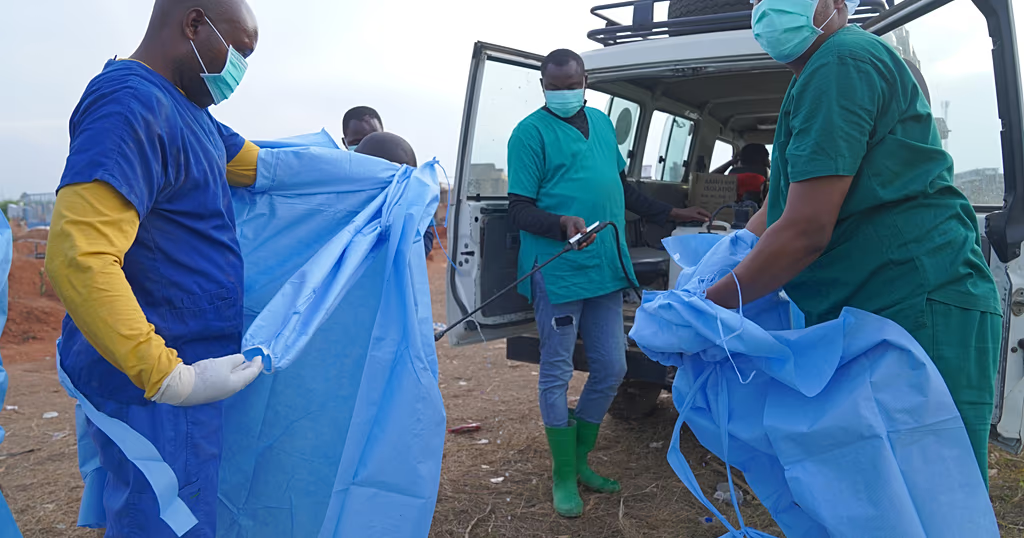
UN chief urges $1.1 billion to fight Ebola outbreak
THE NEWS: United Nations Secretary‑General António Guterres said an additional $1.1 billion is urgently needed to fight the Ebola outbreak, as the...
Read moreDetailsEvery alert that matters — when it happens.

Dangote submits paperwork to build "biggest, deepest" port in Nigeria
Nigeria’s maritime sector is on the cusp of a monumental transformation with the announcement that Dangote Industries has submitted the necessary paperwork to commence construction of what is set to be the nation’s, and indeed Africa’s, largest and deepest deep-water port. This colossal infrastructure project, spearheaded by Africa’s richest man, Aliko Dangote, promises to significantly reshape Nigeria’s trade landscape and bolster its economic standing on the global stage.
The proposed port, strategically located in Lagos, is not just another development; it’s an audacious undertaking designed to address critical bottlenecks in Nigeria’s current port infrastructure. Existing facilities, often plagued by congestion and shallow draft limitations, struggle to accommodate the larger, modern vessels that dominate international shipping. Dangote’s vision directly tackles these challenges, aiming to create a state-of-the-art facility capable of handling supertankers and the next generation of container ships.
This ambitious project is intrinsically linked to Dangote’s massive Lekki Free Trade Zone (LFTZ) refinery, a mega-project designed to refine a substantial portion of Nigeria’s crude oil output. The deep-water port is envisioned as the vital logistical backbone for the refinery, facilitating the efficient import of crude oil feedstock and the export of refined petroleum products. This synergistic approach is expected to streamline operations, reduce turnaround times for vessels, and ultimately lower the cost of doing business for the refinery and potentially for other industries in the region.
The economic implications of such a port are profound. By dramatically increasing Nigeria’s port capacity and efficiency, the project is expected to attract significant foreign direct investment, boost non-oil exports, and create a substantial number of jobs across various skill levels. It will also alleviate pressure on existing ports, such as Apapa and Tin Can Island, which have long been strained by capacity issues and associated logistical nightmares.
Furthermore, the development of a deep-water port aligns with Nigeria’s broader economic diversification goals. By creating a world-class logistics hub, the country can position itself as a major transshipment point for West Africa, capturing a greater share of regional trade. This could lead to increased foreign exchange earnings and a more robust and resilient national economy.
The sheer scale of the project signifies a commitment to tackling infrastructural deficits head-on. While specific financial figures are yet to be fully disclosed, the undertaking is undoubtedly a multi-billion dollar investment, reflecting the confidence of one of Africa’s leading industrialists in Nigeria’s future economic potential. The successful completion of this deep-water port will not only benefit the Dangote Group but will serve as a catalyst for growth across multiple sectors of the Nigerian economy, ushering in a new era of maritime and trade efficiency.
Key Points
Read the Complete Article.
THE NEWS: United Nations Secretary‑General António Guterres said an additional $1.1 billion is urgently needed to fight the Ebola outbreak, as the...
Read moreDetails

Experience the magic of the Nile aboard Kenzy Dahabeya, a luxury boutique sailing cruise that offers an unforgettable journey between...
Read moreDetails





