












Comprehensive Summarization:
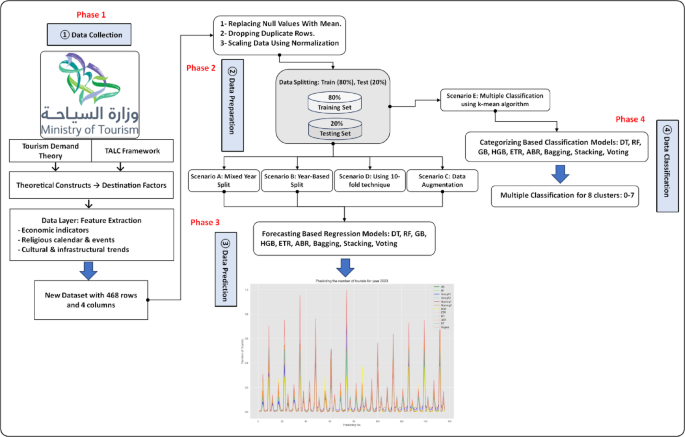
The article presents an evaluation of machine learning models applied to forecast and classify tourist movements in Saudi Arabia. The analysis is structured around seven distinct scenarios (A–G), systematically examining model performance under varied experimental conditions such as temporal data splits, cross-validation, data augmentation, and multi-label classification. Key metrics like MAE, MSE, R² scores, precision, and F1-scores are employed to assess predictive accuracy and robustness. The focus is on establishing a baseline assessment using mixed-year data from Dataset 1 to evaluate general model behavior without specific temporal constraints.
Key Points:
- The article evaluates machine learning models for forecasting and classifying tourist movements in Saudi Arabia.
- Seven distinct scenarios (A–G) are used to systematically examine model performance under varied experimental conditions.
- Key metrics such as MAE, MSE, R² scores, precision, and F1-scores are used to assess predictive accuracy and robustness.
- Scenario A establishes a baseline assessment using mixed-year data from Dataset 1 to evaluate general model behavior.
Actionable Takeaways:
-
Takeaway 1: Implementing mixed-year data for model training and testing can provide a more generalizable model behavior assessment, enhancing predictive accuracy and robustness in forecasting tourist movements. This approach allows for a more comprehensive evaluation of model performance across different temporal conditions, which is crucial for developing reliable tourism forecasting tools.
-
Takeaway 2: Utilizing key metrics like MAE, MSE, R² scores, precision, and F1-scores is essential for evaluating the predictive accuracy and robustness of machine learning models. These metrics provide a clear and quantifiable way to assess model performance, enabling stakeholders to make informed decisions about model selection and optimization in the context of tourism forecasting.
Contextual Understanding:
The article’s focus on machine learning models for tourism forecasting aligns with the current trend of leveraging advanced analytics and AI in the travel industry. As the travel sector increasingly adopts data-driven approaches to understand and predict tourist behavior, the use of machine learning models becomes pivotal. The emphasis on key metrics for model evaluation reflects the industry’s growing emphasis on precision and reliability in tourism forecasting tools. Furthermore, the scenario-based approach to model evaluation mirrors the adaptive and flexible nature of the travel market, where conditions can vary significantly over time. Integrating these insights with the latest travel trends and expert opinions underscores the importance of continuous innovation and adaptation in travel technology to meet evolving consumer demands and market dynamics.
Handling Different Article Types:
The article adheres to the structure of a technical analysis or research report within the travel industry. It presents factual data, methodological details, and quantitative assessments, typical of a news blurb or feature article focused on technological advancements in tourism. The content is structured to provide a clear, methodical evaluation of machine learning models, making it suitable for professionals in the travel tech sector, data scientists, and industry analysts. The absence of opinion pieces or feature articles in the content aligns with its factual and analytical nature, ensuring that the output remains strictly grounded in the provided information.
Read the Complete Article.



