
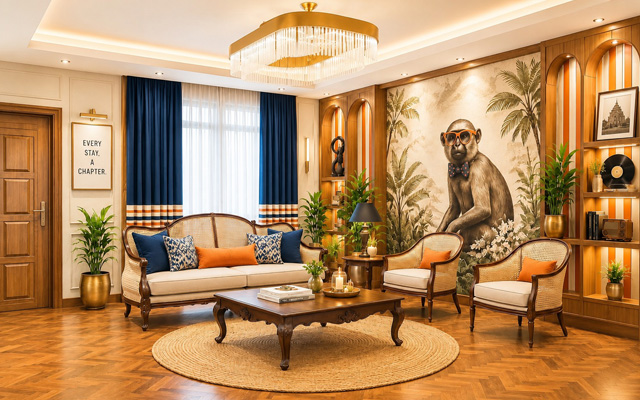
Polo Hotels Group launches boutique brand Chapter Hotels & Resorts
THE NEWS: Polo Hotels Group has launched Chapter Hotels & Resorts, an upscale boutique brand aimed at younger, experience‑led travellers in North‑east...
Read moreDetailsEvery alert that matters — when it happens.

This section presents the tourism evaluation framework, SBM-DNDEA, and spatial econometric models for investigating the operational performance of China’s regional tourism system.
Regarding the performance of tourism supply chains, Huang (tourism supply chains by using the hybrid network data envelopment analysis model. Tour Manag 65:303–316. https://doi.org/10.1016/j.tourman.2017.10.013 ” href=”http://www.nature.com/articles/s41599-024-02741-y#ref-CR20″ id=”ref-link-section-d69499961e1124″>2018) arranged 4 stages in sequence: tourism education, hotels, travel agencies, and destinations. Employees in each stage, rooms provided in a hotel, and guests received by a travel agency were considered separate independent intermediate variables. In this paper, the proposed evaluation framework for China’s regional tourism system builds upon the basic structure of Huang’s (tourism supply chains by using the hybrid network data envelopment analysis model. Tour Manag 65:303–316. https://doi.org/10.1016/j.tourman.2017.10.013 ” href=”http://www.nature.com/articles/s41599-024-02741-y#ref-CR20″ id=”ref-link-section-d69499961e1127″>2018) work. First, the tourism education stage is reduced due to a lack of data availability, and the dining stage is included because it is also an important factor in attracting tourists (Hashimoto and Telfer, tourism: branding the global and the regional product. Tour Geogr 8(1):31–55. https://doi.org/10.1080/14616680500392465 ” href=”http://www.nature.com/articles/s41599-024-02741-y#ref-CR18″ id=”ref-link-section-d69499961e1130″>2006; Renko et al. tourism development in a recovering economy. J Food Prod Mark 16(3):309–324. https://doi.org/10.1080/10454446.2010.485096 ” href=”http://www.nature.com/articles/s41599-024-02741-y#ref-CR44″ id=”ref-link-section-d69499961e1133″>2010). Second, to capture the dynamic character of the operation of the tourism industry, a…
THE NEWS: Polo Hotels Group has launched Chapter Hotels & Resorts, an upscale boutique brand aimed at younger, experience‑led travellers in North‑east...
Read moreDetails

Experience the magic of the Nile aboard Kenzy Dahabeya, a luxury boutique sailing cruise that offers an unforgettable journey between...
Read moreDetails






